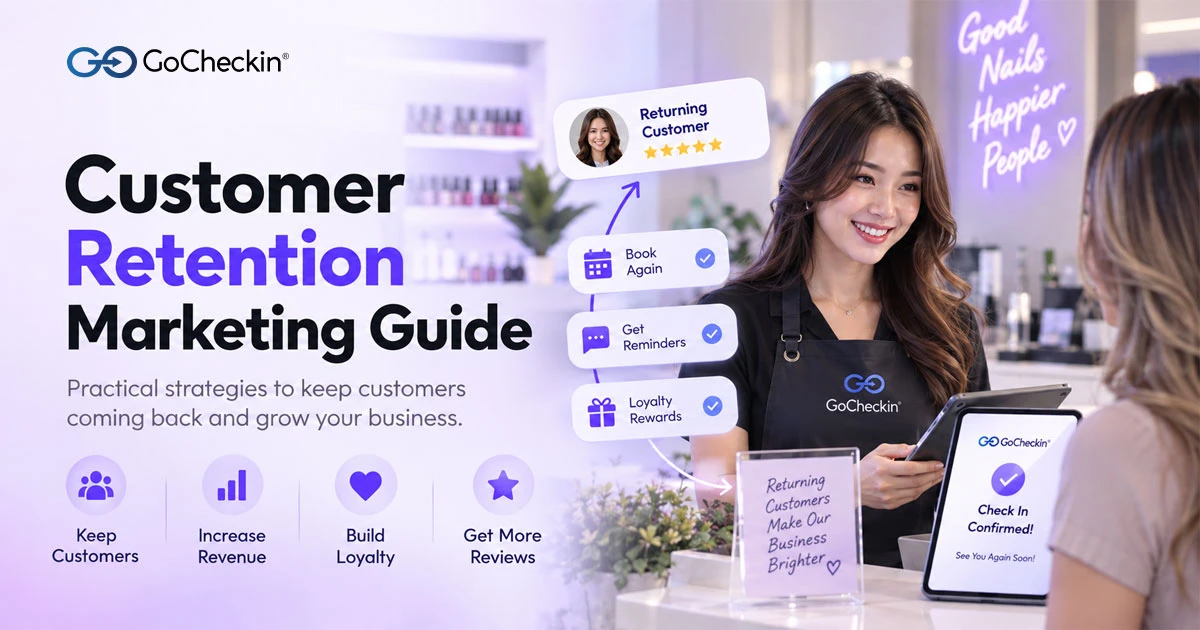
Discover customer retention marketing strategies to increase repeat bookings, customer loyalty, and long-term growth with a better customer experience.
Customer retention metrics including retention rate, repeat customer rate, and customer lifetime valueCustomer Retention Marketing Guide
Customer retention marketing is the process of using marketing strategies, communication, customer service, and personalized experiences to encourage existing customers to continue doing business with a company.
For small businesses, keeping an existing customer can be just as important as attracting a new one. A customer who returns regularly can generate repeat revenue, leave positive reviews, recommend the business to friends, and become a long-term customer.
This Customer Retention Marketing Guide explains what customer retention marketing is, why it matters, and practical strategies small businesses can use to increase repeat visits and customer loyalty.
What Is Customer Retention Marketing?
Customer retention marketing focuses on customers who have already interacted with your business.
Instead of focusing only on acquiring new customers, retention marketing asks:
- How can we encourage customers to come back?
- How can we improve the customer experience?
- How can we personalize communication?
- How can we increase repeat purchases or bookings?
- How can we turn satisfied customers into loyal customers?
For service-based businesses such as nail salons, spas, beauty salons, barbershops, and wellness businesses, retention marketing can be especially valuable because customers often need services repeatedly.
For example, a nail salon customer may return every two to four weeks. A business that consistently provides a convenient experience and communicates with customers at the right time can create a stronger reason for that customer to return.
Why Is Customer Retention Important?
Customer retention can help businesses build more predictable revenue while reducing their dependence on constantly acquiring new customers.
When customers return, businesses already have valuable information about their preferences, previous purchases, appointments, or services.
A strong retention strategy can help businesses:
- Increase repeat bookings
- Improve customer lifetime value
- Reduce customer churn
- Generate more referrals
- Increase positive reviews
- Build stronger customer relationships
- Create more predictable revenue
Retention also works together with customer experience. If customers can easily book an appointment, receive reminders, check in quickly, and communicate with a business, the overall experience becomes more convenient.
7 Customer Retention Marketing Strategies
1. Personalize Customer Communication
Personalization is one of the most useful customer retention strategies.
Instead of sending the same message to everyone, businesses can use customer information to make communication more relevant.
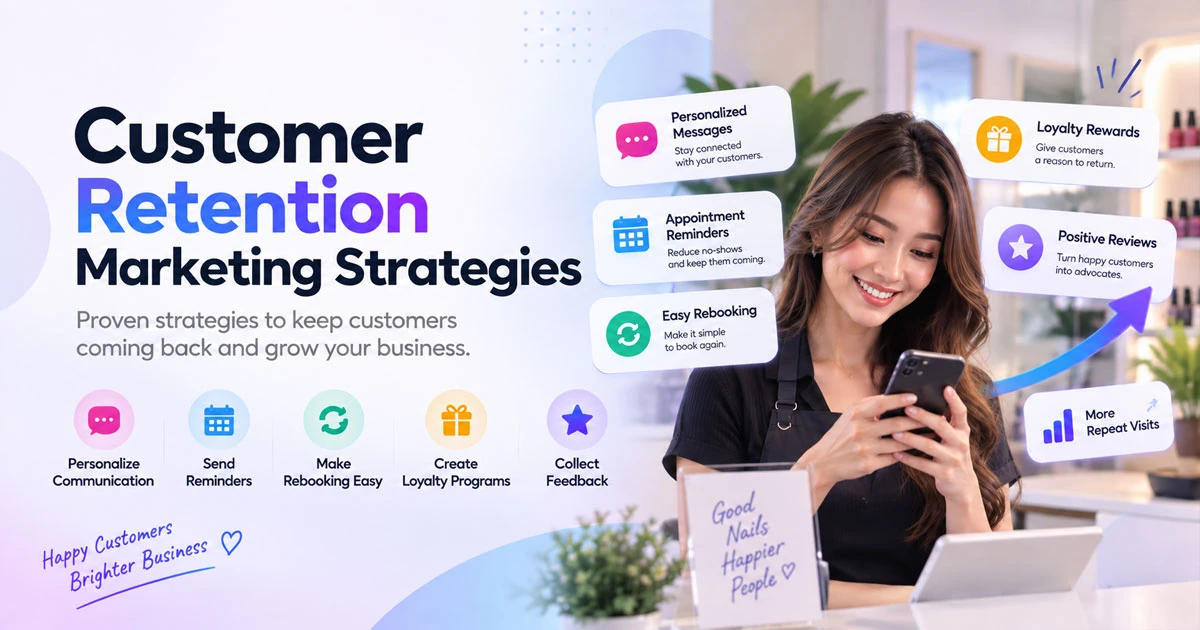
Personalized communication, easy rebooking, loyalty programs, and customer feedback can help businesses increase customer retention.
For example, a salon could send:
“Hi Sarah, it's been three weeks since your last manicure. Would you like to book your next appointment?”
A personalized message can feel more useful than a generic promotional message.
Businesses can personalize communication based on previous services, appointment history, customer preferences, or the time since the customer's last visit.
2. Send Appointment Reminders
Customers sometimes do not return simply because they forget to book their next appointment.
Automated appointment reminders can help businesses stay connected without requiring staff to manually contact every customer.
For example, businesses can send reminders before an appointment and follow-up messages after a customer's visit.
A customer check-in and booking platform such as GoCheckIn can help businesses create a smoother customer journey from booking to arrival and check-in.
This can reduce friction and make the customer experience more convenient.
3. Make Rebooking Easy
The easier it is to book again, the fewer obstacles customers have when they want to return.
Businesses should make their booking process simple and mobile-friendly.
A good rebooking experience can include:
- Online booking
- Clear service options
- Available appointment times
- Automated reminders
- Easy access to the booking page
- Customer information stored for future visits
For recurring services, businesses can also remind customers when it may be time to schedule their next appointment.
4. Create a Customer Loyalty Program
Loyalty programs can give customers an additional reason to continue choosing your business.
A loyalty program could offer:
- Points for each visit
- Discounts after a certain number of visits
- Birthday rewards
- Referral rewards
- VIP benefits
- Exclusive promotions
For example, a beauty salon could reward customers after five or ten visits.
The goal is not simply to offer discounts. A well-designed loyalty program should encourage repeat behavior while making customers feel appreciated.
5. Ask for Feedback
Customer feedback can reveal why customers return—or why they stop coming.
Businesses can ask simple questions after an appointment:
- How was your experience?
- Was the booking process easy?
- How was the service?
- What could we improve?
Feedback can help identify problems with service quality, scheduling, communication, waiting times, or the overall customer experience.
It also shows customers that the business values their opinions.
6. Encourage Reviews From Satisfied Customers
Online reviews can influence both customer acquisition and retention.
After a positive experience, businesses can make it easy for customers to leave a review.
For local businesses, reviews can help strengthen their online reputation and provide social proof for potential customers.
However, businesses should focus on delivering a great experience first. Review requests should be part of the customer journey rather than the entire retention strategy.
7. Use Customer Data to Improve Retention
Customer retention becomes more effective when businesses understand their customer behavior.
Important customer retention data can include:
- Number of visits
- Last visit date
- Booking frequency
- Average customer spend
- Most-used services
- Cancellation rate
- No-show rate
- Customer retention rate
This information can help businesses identify customers who may be becoming inactive.
For example, if a customer normally visits every month but has not booked for three months, the business could send a personalized re-engagement message.
Customer Retention Metrics to Track
Businesses should measure retention rather than relying only on intuition.
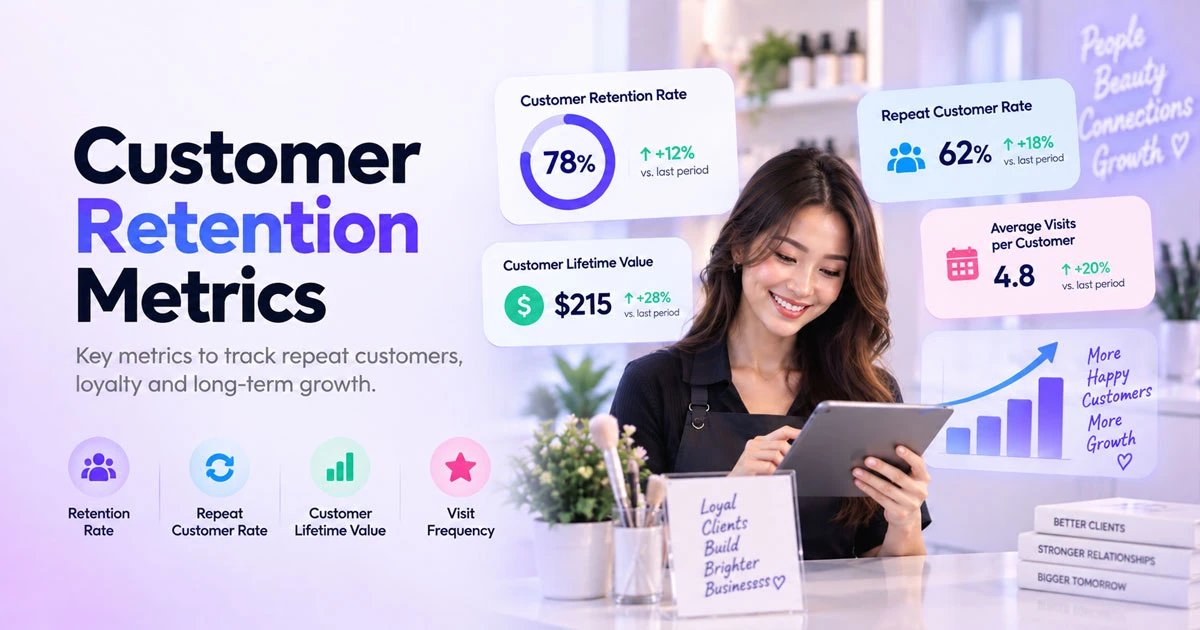
Tracking customer retention metrics helps businesses understand repeat visits, customer loyalty, and long-term customer value.
Customer Retention Rate
Customer Retention Rate (CRR) measures the percentage of customers a business retains during a specific period.
A common formula is:
CRR = [(Customers at End of Period − New Customers Acquired) ÷ Customers at Start of Period] × 100
Tracking CRR over time can help businesses understand whether their retention efforts are improving.
Repeat Customer Rate
Repeat customer rate measures how many customers return and make another purchase or booking.
A higher repeat customer rate generally indicates that customers are coming back instead of making only one transaction.
Customer Lifetime Value
Customer Lifetime Value (CLV) estimates the revenue a customer may generate throughout their relationship with a business.
Increasing visit frequency and customer retention can increase customer lifetime value over time.
How GoCheckIn Can Support Customer Retention
Customer retention is not only about sending marketing messages. It also depends on the experience customers receive every time they interact with a business.
GoCheckIn helps businesses create a more convenient customer journey by connecting booking and customer check-in experiences.
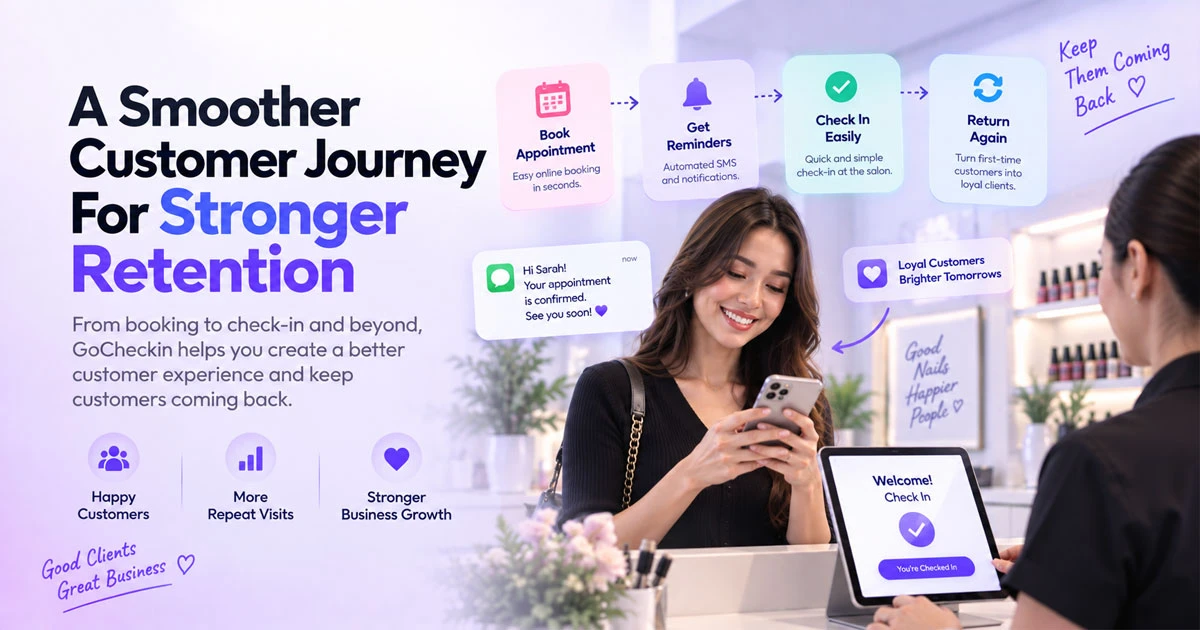
A simple booking and check-in experience can help service businesses create a smoother customer journey and encourage repeat visits.
For businesses such as nail salons, beauty salons, spas, barbershops, and other service businesses, a smoother check-in process can reduce friction when customers arrive.
When booking, reminders, customer information, and check-in work together, businesses can create a more consistent customer experience.
This gives businesses more opportunities to understand customer behavior and build retention campaigns around real customer interactions.
Customer Retention Marketing Best Practices
A successful retention strategy should focus on the entire customer journey.
Businesses should:
- Make booking simple.
- Provide consistent service.
- Send useful reminders.
- Personalize customer communication.
- Make rebooking easy.
- Reward loyal customers.
- Ask for feedback.
- Encourage genuine reviews.
- Track customer behavior.
- Re-engage inactive customers.
The most important principle is consistency. Customer retention is rarely created by one promotion or one marketing campaign. It is built through repeated positive experiences.
Final Thoughts
Customer retention marketing helps businesses move beyond one-time transactions and build long-term customer relationships.
For small businesses, especially appointment-based businesses such as nail salons, spas, beauty salons, and barbershops, retention can be supported by a combination of personalized communication, easy booking, appointment reminders, loyalty programs, customer feedback, and convenient check-in experiences.
By tracking retention metrics and improving the customer journey, businesses can create more opportunities for customers to return.
With tools such as GoCheckIn, businesses can streamline booking and check-in while creating a better foundation for customer retention and long-term growth.